 Polyglot
The Polyglot journal
How to review an interview transcript before sharing it
Two details on different pages can identify someone even after you change every name. Follow a fictional interview from restricted source to a reviewable text excerpt.
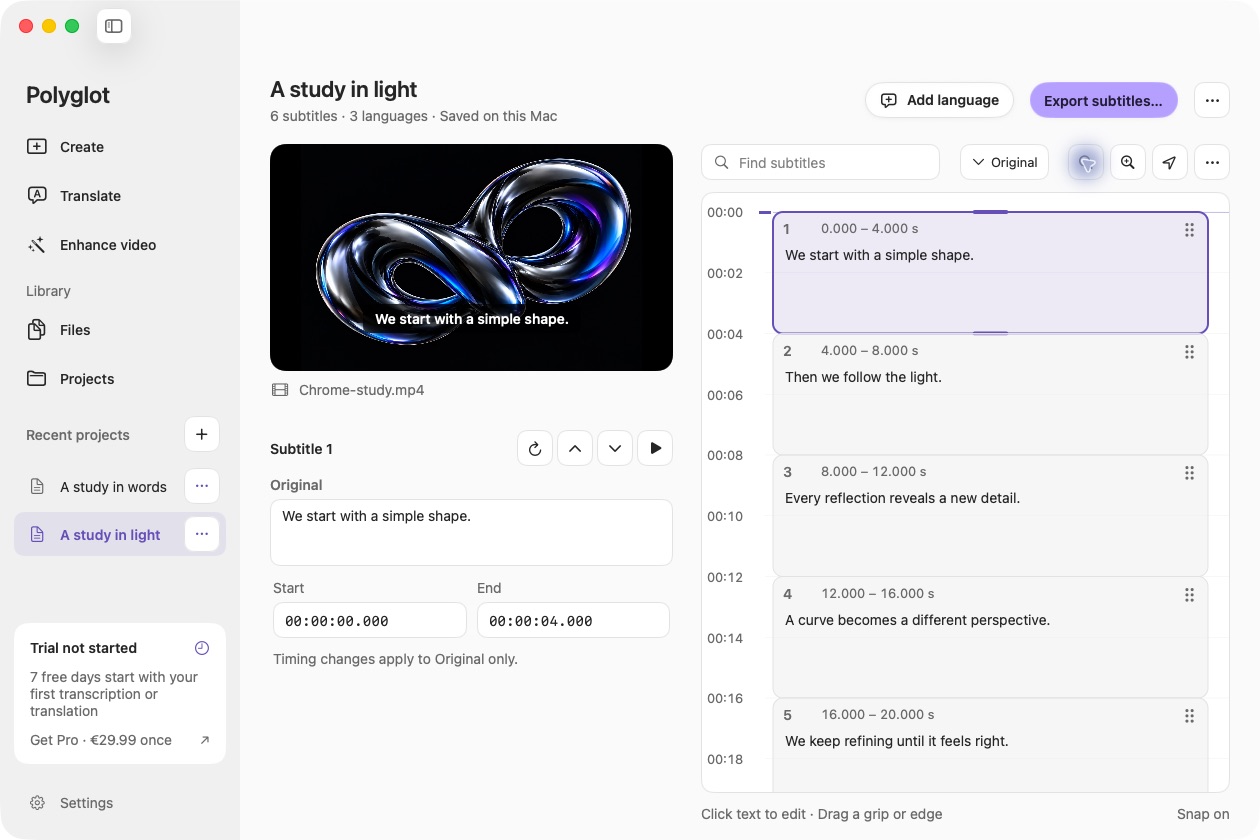
Polyglot 1.11 · Prepared sample project
Start with what the reader needs to learn
Suppose a partner organization wants to understand why interviewees missed evening training sessions. A participant’s name may be easy to replace. The harder detail is the sentence about taking the last ferry home. If the partner knows everyone who uses that crossing, the journey may identify the speaker. Decide what the partner needs to understand about the journey before deciding which words to share.
Write down the approved audience, the question they may use the material to answer and the files they may receive. Check the study’s agreement with participants and its access instructions. Permission to record an interview for internal analysis can have a narrower scope than permission to give a partner the text. If the intended use is unclear, keep the excerpt in the study workspace until the responsible person resolves it.
For this example the partner needs to know whether transport schedules affected attendance. They need the order of events and the consequence for the speaker. They can understand both without the route, employer or date. That gives the editor a concrete basis for choosing what to keep.
Keep a restricted source and make a reading copy
In the restricted workspace, check the passage against the recording, including the interviewer’s preceding question. Resolve transcription errors there. A mistaken place name warrants a source correction. A correctly transcribed place that would give someone away warrants a deliberate edit in a separate sharing copy. Keeping those decisions separate lets another researcher tell what the participant actually said.
Polyglot can help with the first step on an Apple Silicon Mac. Review the timed cues alongside playback and export a text transcript. Make a separate copy of that export for the sharing edits in your approved text editor. Keep the source cues, approved translations and recording under the study’s existing access controls. Polyglot has no automated anonymisation or disclosure assessment.
Give the copy a neutral identifier, such as Interview 04, and write a short editorial note explaining the bracket convention. A pinpoint timestamp can help a restricted reviewer return to the audio. Decide separately whether a recipient needs it, especially when the same recording or a related clip is available elsewhere.
Read distant clues together
In this invented interview, two passages occur several minutes apart. Imagine that the partner knows the island’s timetable and local staff. Changing the speaker’s name to P04 still leaves the first-ferry assignment, the decision to stop attending, a relative’s workplace and a particular meeting. A colleague who recognizes the combination might also identify the sister, who never took part in the interview.
Read the proposed replacement against the research question. The first change keeps the transport constraint and its effect on attendance. The second removes details about a third party with no bearing on that question. Mark the removal explicitly if the surrounding text makes the omission significant. Record the reason in a restricted log rather than attaching the removed words to the excerpt.
Restricted source · invented
“I worked the first ferry
out of Lark Quay. By the
time class ended, the last
boat home had gone. After
that I stopped going to
evening classes.”
Later: “My sister runs the
quay café. She raised it at
the June harbor meeting.”

Proposed sharing copy
“I worked [an early
transport shift]. By the
time class ended, [the last
service home] had gone.
After that I stopped going
to evening classes.”
Later: [passage omitted]
Choose a replacement the evidence can support
A bracketed description signals an editorial substitution. Use the same label when the same person recurs and different labels when two people have distinct roles. Check nicknames, possessives, spelling variants and the interviewer’s prompts. A global replacement of a short name can change unrelated words while missing the surname in a later question. Read the resulting paragraphs aloud to catch broken references.
Try the reverse test. Ask a second authorized reader what conclusion the edited excerpt supports. If they conclude the speaker disliked training, the edit lost the reason for missing it. If the research question specifically concerns island ferry timetables, generalizing the route to public transport may erase the very distinction under study. Request restricted access for that analysis or withhold the excerpt from this audience. Replacing the ferry with an invented bus would introduce false evidence.
Keep an access-controlled decision log with the source location, replacement, reason and reviewer. Where your project needs a key linking labels to identities, restrict it separately from the reading copies. The UK Data Service recommends considering identifiers across related material. Check the participant’s other excerpts, descriptions of the sample and any previously shared quotations visible to this reader. A label that is useful inside one study can link a person across releases.
Inspect the actual outgoing package
Open the files from the folder you plan to transfer. For a text-only handoff, inspect the exported text and filenames. Check headings, speaker lists, introductory notes, comments or tracked changes if a document format carries them. Search for known identifiers, then read the whole package from the perspective of someone familiar with the setting. Search finds words you anticipated. Reading across passages finds clues you missed.
Verify that the package contains only the approved reading copy and any approved explanation of editorial marks. The audio may still contain names and recognizable voices. The video may show a uniform, workstation or face. The original SRT, translated track or project may contain every word removed from the text. A request for playable captions or source media needs its own review of the actual recording and matched track.
Record the recipient, version, scope and the study owner’s decision. If the reader could still connect the clues, narrow the excerpt, restrict access or withhold it. If the text is approved, label it as an edited excerpt and keep that label when someone cites it. Later requests for a longer quotation or a different audience go back through the same review with the new context in view.
Sources & further reading
UK Data Service · Anonymisation for text data
UK Data Service · Common indirect identifiers
UK Data Service · Image, audio and video data
Published by Polyglot using an AI-assisted editorial workflow. How we prepare and update our guides.
Keep exploring.
Try it on your Mac.
Find the right tools for your words and video, with processing on your Mac.
Download nowApple Silicon · macOS 14.4 or later